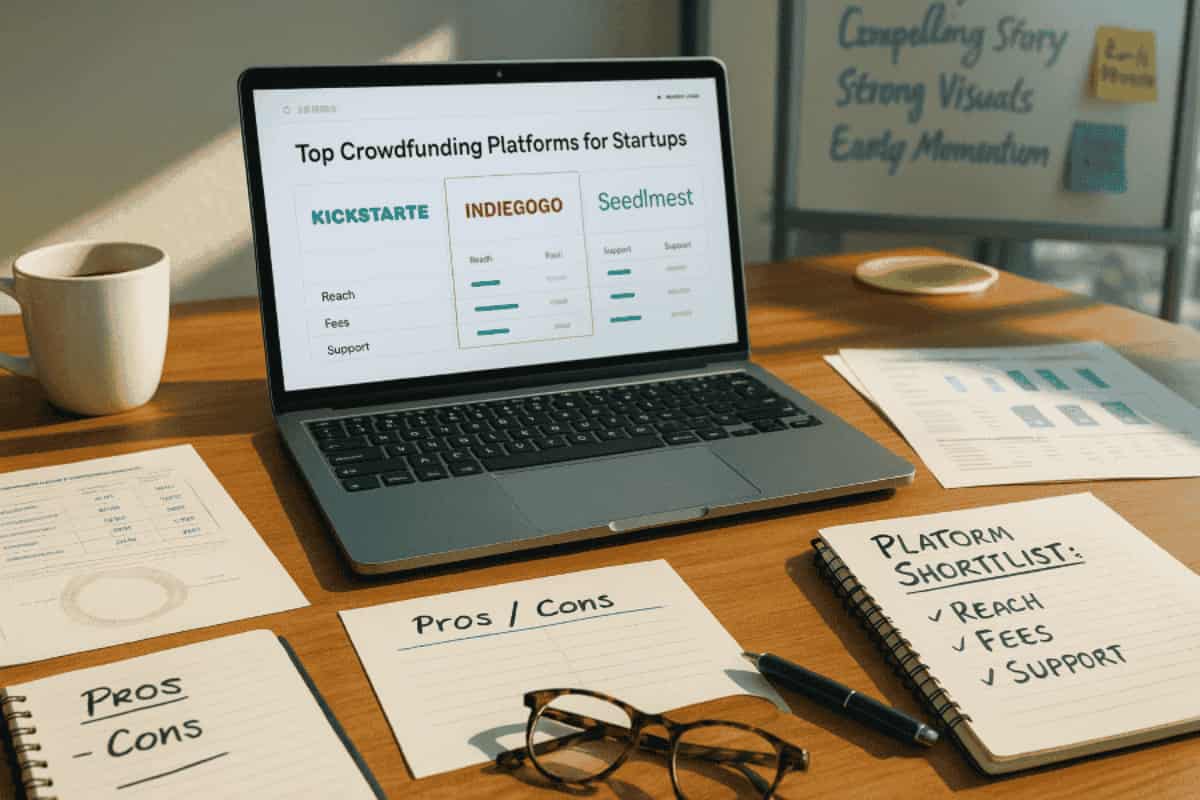
Crowdfunding has fundamentally transformed how startups access capital. What began as a niche mechanism for indie musicians and filmmakers to fund passion projects has evolved into a sophisticated, multi-billion-dollar financing ecosystem that powers product launches, tech companies, consumer brands, and equity fundraising rounds. Today, platforms like Kickstarter, Wefunder, and StartEngine collectively process billions of dollars annually and have opened startup investing to millions of everyday people who previously had no access to early-stage deals. For founders, the implications are profound: you no longer need a warm introduction to a Sand Hill Road VC to raise meaningful capital. You need a compelling story, a validated product concept, and the right platform.
This guide covers the best crowdfunding platforms for startup founders in 2025–2026, organized by type, with clear guidance on which model fits which kind of company.
Understanding the Four Types of Crowdfunding
Before diving into individual platforms, it’s critical to understand that “crowdfunding” is not a single category — it encompasses four fundamentally different models, each suited to a different business type, stage, and founder objective:
- Reward-based crowdfunding: Backers contribute money in exchange for a product, perk, or experience — not equity. Ideal for physical products and consumer hardware
- Equity crowdfunding: Investors receive actual shares or a financial instrument (SAFE, convertible note) in exchange for capital. Regulated by the SEC in the US under Regulation Crowdfunding (Reg CF) and Regulation A+
- Debt crowdfunding: Backers lend money that must be repaid, typically with interest. Functions similarly to peer-to-peer lending
- Donation crowdfunding: Contributors give without expecting financial return. Primarily used by nonprofits and social causes
For startup founders seeking growth capital, equity crowdfunding is the most relevant model. For founders launching a physical product and seeking market validation alongside funding, reward-based crowdfunding is the more strategic choice. Understanding which model you need is the first decision to make before evaluating any platform.
Reward-Based Platforms
1. Kickstarter — The Gold Standard for Product Launches
Kickstarter is the most recognized crowdfunding platform in the world and remains the first choice for founders launching physical products, consumer hardware, tech gadgets, and creative projects. Since its launch in 2009, Kickstarter has funded more than 284,000 successful projects and processed over $9 billion in pledges as of 2025. The platform operates on an all-or-nothing model: you set a funding goal, and you only receive the money if that goal is reached within your campaign window. If you fall short, backers are refunded in full.
For startup founders, Kickstarter serves a dual purpose that no equity platform can replicate: it simultaneously raises capital and validates market demand. A successful Kickstarter campaign is concrete, public proof that real consumers want your product at the price point you’ve set — evidence that resonates powerfully with angel investors and VCs in subsequent fundraising conversations.
Kickstarter’s all-or-nothing model also creates strategic discipline. Founders must set realistic goals, build a genuine audience before launch, and invest in campaign marketing to convert interest into pledges. The platform charges a 5% fee on successfully funded campaigns, plus payment processing fees of approximately 3–5%.
Best for: Physical product startups, consumer tech, design, gaming, and creative companies seeking market validation alongside capital
Typical raise: $10,000–$5M+
Platform fee: 5% + payment processing
2. Indiegogo — Best for Global Flexibility
Indiegogo is Kickstarter’s closest competitor in the reward-based space, with one critical structural difference: it offers flexible funding alongside its fixed-goal model. Under the flexible funding option, founders keep whatever amount they raise — even if they don’t hit their target. This makes Indiegogo a more accessible choice for first-time campaigners who need capital regardless of whether they hit a specific threshold.
Indiegogo also offers significantly stronger international reach than Kickstarter, supporting campaigns from founders in over 235 countries and territories. For Latin American entrepreneurs launching global products, Indiegogo’s platform infrastructure and global backer community provide reach that no regionally focused platform can match.
Indiegogo’s InDemand feature is particularly valuable for founders who have already run a successful campaign — it allows them to continue accepting pre-orders and pledges indefinitely after the campaign ends, turning a one-time event into an ongoing sales channel.
Best for: International founders, first-time campaigners, hardware startups seeking ongoing pre-order sales
Platform fee: 5% (flexible or fixed funding)
Equity Crowdfunding Platforms
3. Wefunder — Best Community-Driven Equity Platform
Wefunder is one of the most active equity crowdfunding platforms in the United States, with over one million registered investors who have collectively funded more than 2,000 startups since the platform’s founding in 2012. Wefunder operates under SEC Regulation Crowdfunding (Reg CF), which allows non-accredited investors — everyday Americans — to invest in private startups for the first time in history.
What makes Wefunder particularly compelling for founders is its community ethos. The platform actively encourages founders to build a genuine relationship with their investor community — sharing updates, engaging in discussion threads, and treating small investors as early brand advocates rather than passive capital providers. Many Wefunder-backed startups report that their smallest investors become their most loyal customers and evangelists.
Wefunder supports both equity and debt crowdfunding, with SAFE notes and priced equity rounds both available as instruments. Minimum investment amounts are accessible — often as low as $100 — which maximizes the breadth of a founder’s potential investor community.
Best for: Consumer-facing tech startups, community-driven brands, founders who want to build a loyal investor-customer base
Typical raise: $50,000–$5M (Reg CF cap is $5M under current SEC rules)
Platform fee: 7.9% of funds raised
4. StartEngine — Best for Scale and Visibility
StartEngine is the largest equity crowdfunding platform by number of active campaigns and investor registrations in the US, with over 1.8 million registered potential investors on the platform as of 2025. It supports both Regulation CF campaigns (up to $5M) and Regulation A+ campaigns (up to $75M annually), making it one of the few platforms capable of supporting startup fundraising at a scale that genuinely competes with early-stage institutional venture.
StartEngine’s scale translates into real marketing leverage for founders: campaigns benefit from the platform’s email distribution, featured placement, and media partnerships that can drive millions of campaign page views. The platform also operates a secondary market — StartEngine Secondary — where investors can buy and sell shares in StartEngine-hosted companies, a liquidity feature that makes equity investments more attractive to backers than competing platforms.
StartEngine charges a 7% fee on capital raised plus an equity kicker (2% of securities sold), but for founders who leverage the platform’s full marketing capabilities, the investor reach and deal visibility justify the cost.
Best for: Growth-stage tech startups targeting large raises; founders who want maximum investor reach and media exposure
Typical raise: $100,000–$75M (Reg A+)
Platform fee: 7% cash + 2% equity
5. SeedInvest — Best for Vetted, Quality Investors
SeedInvest occupies a differentiated position in the equity crowdfunding landscape by being explicitly selective on the supply side — only about 1% of companies that apply are accepted onto the platform. This rigorous curation creates a significantly higher-quality investor audience than open platforms, as sophisticated angels and family offices actively browse SeedInvest specifically because they trust the quality of its deal flow.
For founders, acceptance onto SeedInvest is itself a signal of credibility — the vetting process includes financial audits, team assessments, and market analysis that produce documentation useful in subsequent institutional fundraising conversations. SeedInvest was acquired by Circle (the fintech infrastructure company) in 2019, giving it deep connections to the blockchain and fintech investor community in particular.
Best for: Traction-ready tech startups with strong metrics seeking quality over quantity in their investor base
Typical raise: $250,000–$10M
Platform fee: 7.5% + 5% equity
6. Fundable — Best for Accredited Investor Access
Fundable is an equity and rewards crowdfunding platform purpose-built for startups, with a particular emphasis on connecting founders with accredited investors. Unlike Reg CF platforms that open investments to everyone, Fundable’s equity campaigns are restricted to accredited investors — meaning check sizes are larger and investor profiles are more institutional.
Fundable has facilitated over $700 million in investments from more than 200,000 accredited investors and offers guided fundraising services — pitch deck creation, investor sourcing, outreach email drafting, and investor coaching — that make it an unusually full-service platform for founders who are new to institutional fundraising.
Best for: B2B SaaS and tech startups seeking accredited investors and hands-on fundraising support
Typical raise: $50,000–$10M
Pricing: Flat monthly subscription (~$179/month) rather than percentage fee
Specialized Platforms Worth Knowing
7. IFundWomen — Best for Female Founders
IFundWomen is a crowdfunding and grants platform designed exclusively for women-led businesses, offering both reward-based campaigns and grant matching alongside coaching, network access, and business education resources. For female startup founders — who receive a disproportionately small share of VC funding — IFundWomen provides a targeted environment where their businesses are evaluated on their own merits, supported by a community of aligned investors and champions.
8. Kiva — Best for Microfinance and Global Impact
Kiva operates as a debt crowdfunding platform with a mission focus, connecting underserved entrepreneurs — including many in Latin America, Africa, and Southeast Asia — with lenders who provide 0% interest microloans. For early-stage founders in emerging markets who need small amounts of capital ($1,000–$15,000) to launch, Kiva’s zero-interest model and global lender community make it one of the most accessible and founder-friendly financing tools in existence.
How to Choose the Right Platform
| Factor | Best Platform Choice |
|---|
| Factor | Best Platform Choice |
|---|---|
| Physical product launch | Kickstarter or Indiegogo |
| Community-driven brand | Wefunder |
| Large equity raise ($1M+) | StartEngine or SeedInvest |
| Accredited investors only | Fundable |
| Women-led startup | IFundWomen |
| Emerging market / microfinance | Kiva |
| International reach | Indiegogo |
The best crowdfunding campaigns share one characteristic above all else: they are built long before launch day. The founders who raise the most on these platforms spend months building an audience, testing their messaging, securing early commitments from their personal networks, and creating campaign content that converts a visitor into a backer in under 60 seconds. The platform is just the stage — the preparation is the performance.